


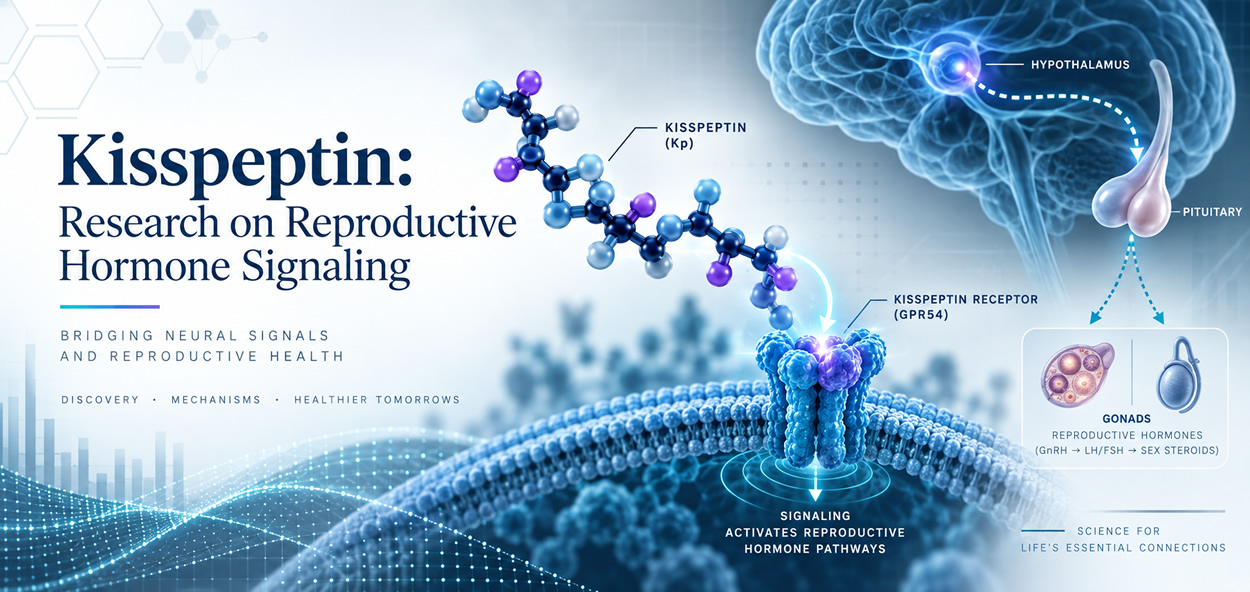
Kisspeptin is a naturally occurring peptide studied for its role in reproductive hormone signaling, fertility, sexual function, and regulation of the hypothalamic-pituitary-gonadal axis.
Kisspeptin is produced by specialized neurons in the hypothalamus, a region of the brain involved in controlling many hormone systems. It plays an important role in triggering the release of gonadotropin-releasing hormone, or GnRH.
GnRH then signals the pituitary gland to release luteinizing hormone, or LH, and follicle-stimulating hormone, or FSH. These hormones help regulate the ovaries and testes, making kisspeptin an important upstream signal in reproductive biology.
What Has Kisspeptin Research Studied?
Kisspeptin research spans reproductive endocrinology, fertility, IVF, sexual function, hormone signaling, and emerging areas outside reproduction.
- GnRH signaling: Researchers have studied how kisspeptin activates the reproductive hormone pathway beginning in the hypothalamus.
- Fertility and IVF: Clinical studies have examined kisspeptin as a trigger for egg maturation during fertility treatment.
- LH and FSH release: Human research has documented changes in reproductive hormones following kisspeptin stimulation.
- Sexual desire and arousal: Studies in both women and men have examined kisspeptin's effects on brain activity and sexual response.
- Bone and metabolic research: Smaller studies have explored effects on bone-related hormone markers and other biological systems.
How Does Kisspeptin Work?
Kisspeptin acts through a receptor known as KISS1R, which is found on neurons involved in reproductive hormone signaling.
When kisspeptin activates these receptors, it stimulates the release of GnRH from the hypothalamus.
GnRH then signals the pituitary gland to release LH and FSH. These hormones act on the ovaries and testes and influence ovulation, sperm production, estrogen, testosterone, and other reproductive processes.
Because kisspeptin sits near the top of this hormone pathway, researchers have been interested in whether influencing kisspeptin signaling may affect several downstream reproductive hormones at once.
Why Is Kisspeptin Important in Reproductive Biology?
The importance of kisspeptin became especially clear through research involving people with changes in the kisspeptin receptor gene.
Researchers found that disruptions in kisspeptin signaling could prevent normal puberty and reproductive development.
These findings helped establish kisspeptin as a central regulator of the reproductive hormone system rather than simply one of many secondary signaling molecules.
Its position near the top of the reproductive hormone pathway has made it an important research target in fertility, puberty, hormone regulation, and reproductive medicine.
What Has Research Found About Fertility?
Fertility has become one of the most developed areas of human kisspeptin research.
Clinical studies have examined kisspeptin as a way to trigger the hormonal events involved in final egg maturation during IVF treatment.
Kisspeptin stimulates the body's own GnRH system, which then produces a rise in LH and FSH. These hormones are involved in the final stages of egg maturation before ovulation.
This upstream mechanism differs from some traditional fertility triggers that act further down the hormone pathway.
Kisspeptin and IVF Research
Researchers have studied kisspeptin-54 as a trigger for egg maturation during in vitro fertilization.
In Phase 2 clinical research, kisspeptin successfully triggered oocyte maturation in women undergoing fertility treatment.
One particular area of interest has been women considered at higher risk for ovarian hyperstimulation syndrome, or OHSS.
Because kisspeptin works through the body's natural GnRH signaling pathway, researchers have investigated whether it may produce a different hormonal response than conventional trigger approaches.
Studies cited in the source material reported successful egg maturation while also generating interest in kisspeptin as a potential way to reduce the risk of excessive ovarian stimulation in certain IVF populations.
What Has Research Found About Hormone Release?
Human studies have consistently shown that kisspeptin can activate the reproductive hormone axis.
Following kisspeptin stimulation, researchers have measured increases in LH and other downstream reproductive hormones.
In men, this signaling can influence testosterone production. In women, the downstream pathway can affect estrogen production, follicular development, and ovulatory signaling.
The strength of these responses can vary depending on sex, reproductive stage, baseline hormone levels, and the timing of exposure.
Kisspeptin and Sexual Desire Research
Kisspeptin has also become a subject of research involving sexual desire and arousal.
Randomized human studies have examined women with hypoactive sexual desire disorder and men with similar concerns.
Researchers have used brain imaging and physiological measurements to study how kisspeptin changes activity in brain regions involved in sexual attraction, reward, emotion, and arousal.
These studies suggest that kisspeptin's biological role may extend beyond reproductive hormone release alone and may also influence neural pathways involved in sexual behavior.
Why Might Kisspeptin Affect Both Hormones and Desire?
Reproduction depends on communication between the brain and the endocrine system.
Kisspeptin is positioned at an intersection between these systems. It can influence GnRH and reproductive hormones while also interacting with brain regions involved in emotional and sexual processing.
This makes kisspeptin especially interesting to researchers studying the relationship between hormone signaling, attraction, motivation, and reproductive behavior.
What Has Research Found About Bone Metabolism?
Some human research has also examined kisspeptin outside its better-known reproductive role.
Studies in healthy men have investigated short-term changes in markers associated with bone metabolism following kisspeptin exposure.
This area is connected to the broader relationship between reproductive hormones and bone biology.
The evidence is much smaller than the fertility and reproductive hormone research, but it illustrates the expanding interest in kisspeptin's biological effects beyond ovulation and reproductive signaling.
What Other Areas Are Being Studied?
Researchers continue to investigate kisspeptin signaling in systems outside traditional reproductive endocrinology.
Preclinical research has explored potential relationships with metabolism, liver biology, and other physiological processes.
These areas remain much earlier in development than the human fertility and reproductive hormone research.
They are useful primarily for understanding the broader biological roles of the kisspeptin signaling system.
What Has Safety Research Reported?
Kisspeptin has been studied in multiple human clinical research settings, including fertility and reproductive hormone studies.
Researchers have examined mood and anxiety because kisspeptin also interacts with brain signaling pathways. Studies cited in the source material did not find increased anxiety during the experimental conditions examined.
Because kisspeptin activates the reproductive hormone pathway, changes in LH, FSH, estrogen, testosterone, and related hormones are expected biological effects of the signaling process.
In fertility research, investigators have paid particular attention to ovarian response and the possibility of ovarian hyperstimulation.
Larger and longer clinical studies would provide additional information about less common effects and long-term use across different populations.
How Does Kisspeptin Compare With hCG in Fertility Research?
| Compound | Primary Mechanism | Research Focus |
|---|---|---|
| Kisspeptin | Stimulates GnRH release upstream in the reproductive hormone pathway | Egg maturation, reproductive hormone signaling, IVF research, and OHSS-related investigation |
| hCG | Acts downstream by mimicking LH activity | Established ovulation and egg-maturation triggering in fertility treatment |
The major difference is where the two signals enter the reproductive hormone pathway.
Kisspeptin acts upstream by stimulating GnRH, which then causes the pituitary gland to release LH and FSH.
hCG acts further downstream and produces effects similar to LH at reproductive tissues.
This difference in mechanism is one reason researchers have studied kisspeptin as an alternative approach for triggering egg maturation in selected IVF populations.
Why Is Kisspeptin of Research Interest?
Kisspeptin remains scientifically important because it occupies a central position in the reproductive hormone system.
Research has examined puberty, fertility, GnRH signaling, LH and FSH release, IVF-related egg maturation, sex hormone production, sexual desire, and brain activity associated with reproductive behavior.
Its ability to connect neurological signaling with endocrine function makes it useful for studying reproduction as a coordinated brain-and-hormone process rather than as a series of isolated hormones.
Human clinical research is also more developed for kisspeptin than for many experimental peptides, particularly in fertility and reproductive endocrinology.
Research Sources
- Human research examining kisspeptin and GnRH signaling
- Phase 2 fertility and IVF studies involving kisspeptin-54
- Research examining kisspeptin and ovarian hyperstimulation risk
- Randomized studies involving sexual desire and brain activity
- Research examining LH, FSH, testosterone, and estrogen signaling
- Studies exploring kisspeptin and bone-related hormone markers